2.2 Proving Lines Parallel
- Prove that two lines cut by a transversal are parallel using the converses of parallel line angle relationship theorems
- Use properties of parallel lines and transversals to solve real-world and mathematical problems
- Write and use flow proofs
Assignment
- One vocabulary definition
- Option 1: p83 10–15, 19, 20–24 (12 problems, PDF link)
- Option 2: IXL (SmartScore ≥70 on each)
Last section, we looked at parallel lines cut by a transversal and found pairs of angles that would always be congruent or supplementary. It turns out that this works in reverse1. If you have two lines that may be parallel, then you can use those angle pairs to prove they are parallel.
Example: Using Angles to Prove Lines Parallel
Figure 2.2.1 Four lines with questionable parallelism.
In Figure 2.2.1 above, what do you need to know about $\angle 1$ and $\angle 2$ to prove $c \parallel d$?
What about $\angle 2$ and $\angle 3$ for $a \parallel b$?
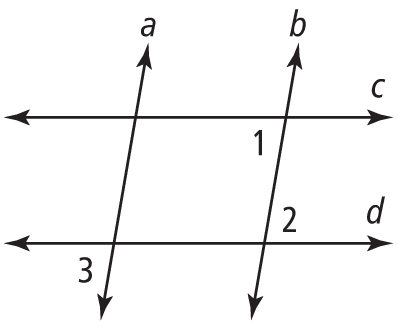
SOLUTION $\angle 1$ and $\angle 2$ are alternate interior angles around the transversal $b$. If they are congruent, then that would make line $c$ parallel to line $d$.
Similarly, $\angle 2$ and $\angle 3$ are alternate exterior angles around $d$. If they are congruent, then $a \parallel b$.
$\blacksquare$
Example: Finding Values for Parallel Lines
Figure 2.2.2 Another four lines we want to be parallel.
In Figure 2.2.2 above, let the following be true.
- $m\angle 1 = 3x + 15$
- $m\angle 2 = 5x$
- $m\angle 3 = 2x + 40$
Find the value for $x$ that makes $g \parallel h$.
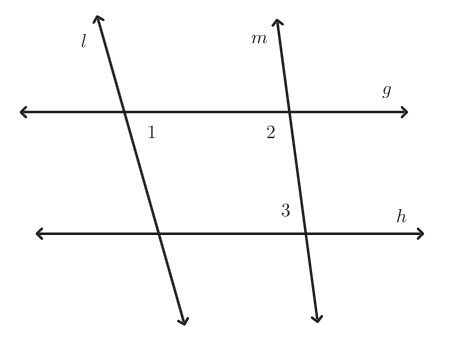
SOLUTION Our lines in question have two transversals, but only $m$ has two angles we can use. $\angle 2$ and $\angle 3$ are same-side interior angles, so they must be supplementary for $g$ to be parallel to $h$.
\[\begin{align} 180^\circ &= m\angle 2 + m\angle 3 \\[0.5em] 180 &= (5x) + (2x + 40) \\ 180 &= 7x + 40 \\ 140 &= 7x \\ 20 &= x \end{align}\]$\blacksquare$
-
Unlike contrapositives, converses must be proven true since they are not automatically true. Example 2 gives us a proof for why alternate interior angles can prove lines are parallel. ↩