2.1 Parallel Lines
- Define parallel lines using the undefined terms point and line
- Prove theorems about lines and angles
- Use theorems to find the measures of angles formed by parallel lines and a transversal
Assignment
- p76 12–13, 15–20, 23–28 (14 problems, PDF link)
Additional Resources
- Transversals: name angle pairs
- Transversals of parallel lines: find angle measures
- Transversals of parallel lines: prove angle relationships
Parallel Lines and Transversals
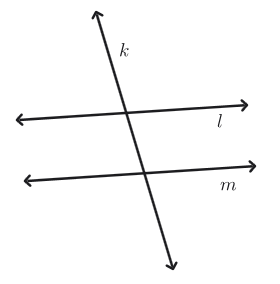
What we’re looking at for the next are parallel lines, or lines that don’t intersect. In this section specifically, we’ll look at parallel lines with a transversal cutting through them.
Figure 2.1.1 Lines $l$ and $m$ are parallel, $l\parallel m$, and transversal $k$ intersects both of them.
Another way to look at parallel line is that they have the same slope, or tilt. A line that is parallel to another is just a copy shifted.
Figure 2.1.2 Parallel lines have the same slope.
Since parallel lines are just shifted up or down, the angles formed by them and a transversal will be congruent. In the picture below angles that share the same position are congruent.
Figure 2.1.3 Corresponding angles formed by parallel lines and a transversal.
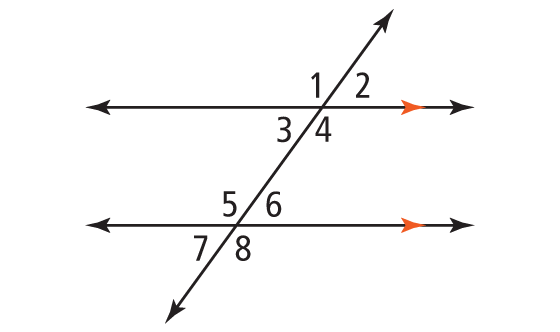
That means ${\angle 1 \cong \angle 5}$, ${\angle 2 \cong \angle 6}$, ${\angle 3 \cong \angle 7}$, and ${\angle 4 \cong \angle 8}$. These are called corresponding angles.
Corresponding Angles
If a transversal intersects two parallel lines, then corresponding angles are congruent.
In fact, because of linear pairs, you can derive each angle measure given just one.
Example: Parallel Lines and Traversal Angles
Using the figure above, if $m\angle 1= 120^\circ$, what are the remaining angle measures?
SOLUTION Just working around the top set of angles, $\angle 1$ and $\angle 2$ are a linear pair, making them supplementary. So, $m\angle 2 = 60^\circ$. $\angle 4$ matches up with $\angle 1$ as a vertical angle making that one also $120^\circ$. Similar reasoning will get you $\angle 3$ which is $60^\circ$.
Since the bottom set are corresponding angles, we can just match the angles to get the remaining ones. $\angle 1$ goes with $\angle 5$, $\angle 2$ with $\angle 6$, $\angle 3$ with $\angle 7$, and $\angle 4$ with $\angle 8$.
$\blacksquare$
Named Pairs
Once you have the corresponding angles relationship under control, the only thing you need to worry about are the names that are used for some of the pairs.
First up are the pairs of alternate angles, which are always congruent to each other. These have different vertexes, lie on opposite sides of the transversal, and are either interior or exterior. Using the angles from Figure 2.1.3 as reference, your alternate exterior angles are $\angle 1$ and $\angle 8$, and $\angle 2$ and $\angle 7$. That means the alternate interior angles are $\angle 3$ and $\angle 6$, and $\angle 4$ and $\angle 5.$
The only other named pair are the same-side interior angles, or consecutive interior angles, which are supplementary to each other. These also have different vertexes, but lie on the same side of the transversal. Also, this is for interior angles only, so that makes $\angle 4$ and $\angle 6$, and $\angle 3$ and $\angle 5$ are the two pairs of same-side interior angles.