2.3 Parallel Lines and Triangles
- Use lines constructed parallel to another line to solve problems and prove themselves
- Use the sum of the angle measures in a triangle to solve problems
Assignment
- Option 1: p90 14–22, 24–25, 28–34 (21 problems, PDF link)
- Option 2: IXL (SmartScore ≥70 on each)
The Interior of a Triangle
A straight angle is an angle that measures $180^\circ$ and gets its name from it being just a straight line.
Figure 2.3.1 A straight angle.

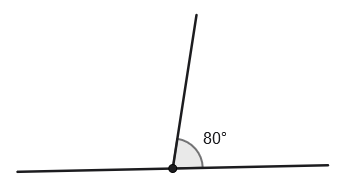
If we take a straight angle and split it, we get supplementary angles. And if we know one of the angle measures, then we can find the other.
Figure 2.3.2 Supplementary angles with one measuring $80^\circ$. That would make the other one $100^\circ$.
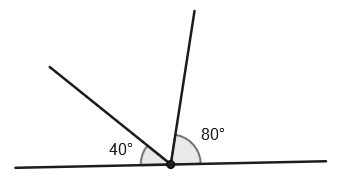
We can keep going. If we split it again so we have three angles, knowing two means we can find the third.
Figure 2.3.3 A straight angle split into three smaller angles. Since we know two measures, we can find the third which is $60^\circ$.
And if we add a line parallel and extend the others, we get a triangle. Using what we know about alternate interior angles, we can match up the new angles.
Figure 2.3.4 A parallel line is added and with the alternate interior angles labeled.
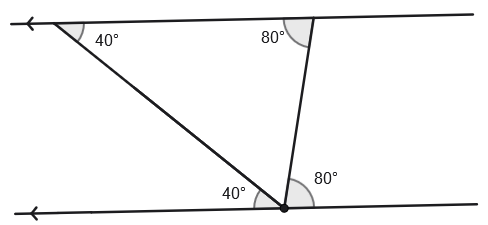
Since the straight angle was split into three, we know those three have to add up to $180^\circ$. And because of our parallel lines, our triangle shares the same angles. That means our triangle’s angles have to also have to add up to $180^\circ$. And this fact hold true for all triangles.
Triangle Angle-Sum Theorem
The sum of angles of a triangle is equal $180^\circ$.
The Exterior of a Triangle
We can get a useful piece of information out of the whole $180^\circ$ property of triangles. Below is a triangle with one external angle labeled. These are made by extending one of the sides past a vertex.
Figure 2.3.5 A triangle with on external angle labeled.
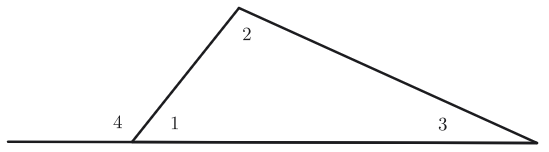
Two things to keep in mind for what’s coming next:
- The sum of the interior angles is $180^\circ$ and
- linear pairs are supplementary and also add up to $180^\circ$.
Using that, we can write two equations.
\[\begin{align} m\angle 1 + m\angle 2 + m\angle 3 &= 180^\circ \\ m\angle 1 + m\angle 4 &= 180^\circ \end{align}\]That must mean
\[\begin{align} m\angle 2 + m\angle 3 = m\angle 4 \end{align}\]This gives us our other theorem for this section.
Triangle Exterior Angle Theorem
The measure of a triangle’s exterior angle equals the sum of the nonadjacent interior angles.